Different manufacturing techniques significantly impact the performance and durability of graphite bushings. Here’s how various methods affect these attributes:
Sintering:
Process: Sintering involves heating graphite powder to a high temperature under pressure to fuse the particles together.
Impact on Performance: This process enhances the density and strength of the graphite, resulting in improved load-bearing capacity and resistance to wear. It also provides a uniform microstructure, which contributes to consistent performance.
Impact on Durability: Sintered graphite bushings generally exhibit better thermal stability and resistance to high temperatures. They are less likely to deform or degrade under stress, leading to longer service life.
Impregnation:
Process: Impregnation involves introducing a resin or binder into the porous structure of the graphite, which is then cured to solidify the material.
Impact on Performance: Impregnated graphite bushings often have enhanced mechanical strength and improved wear resistance. The impregnation process can also improve the bushing’s ability to withstand harsh operating conditions and reduce the friction coefficient.
Impact on Durability: The impregnated material can help to seal the graphite, making it more resistant to chemical attack and moisture. This increases the bushings' longevity and reliability in adverse environments.
Graphite Machining:
Process: Machining involves shaping graphite to precise dimensions using cutting tools or abrasive methods.
Impact on Performance: Precision machining ensures that the graphite bushings meet exact specifications, which is crucial for applications requiring tight tolerances. Proper machining improves the fit and function of the bushings within the assembly.
Impact on Durability: Well-machined bushings exhibit consistent performance and reduce the risk of issues such as uneven wear or misalignment. However, the surface finish from machining can influence the bushing's friction and wear characteristics.
Molding:
Process: Molding involves forming graphite into shapes using molds, often with the application of heat and pressure.
Impact on Performance: Molding can produce graphite bushings with complex shapes and consistent quality. The performance of molded bushings can be controlled by adjusting the molding parameters, such as temperature and pressure.
Impact on Durability: Molding can lead to variations in density and strength depending on the process parameters. Properly controlled molding results in durable bushings with good mechanical properties.
Baking or Carbonization:
Process: This involves heating graphite at high temperatures to remove volatile components and enhance the carbon structure.
Impact on Performance: The carbonization process increases the purity and electrical conductivity of the graphite, which can improve performance in applications requiring high thermal or electrical conductivity.
Impact on Durability: Baking increases the structural integrity of the graphite, leading to improved resistance to thermal expansion and mechanical stress.
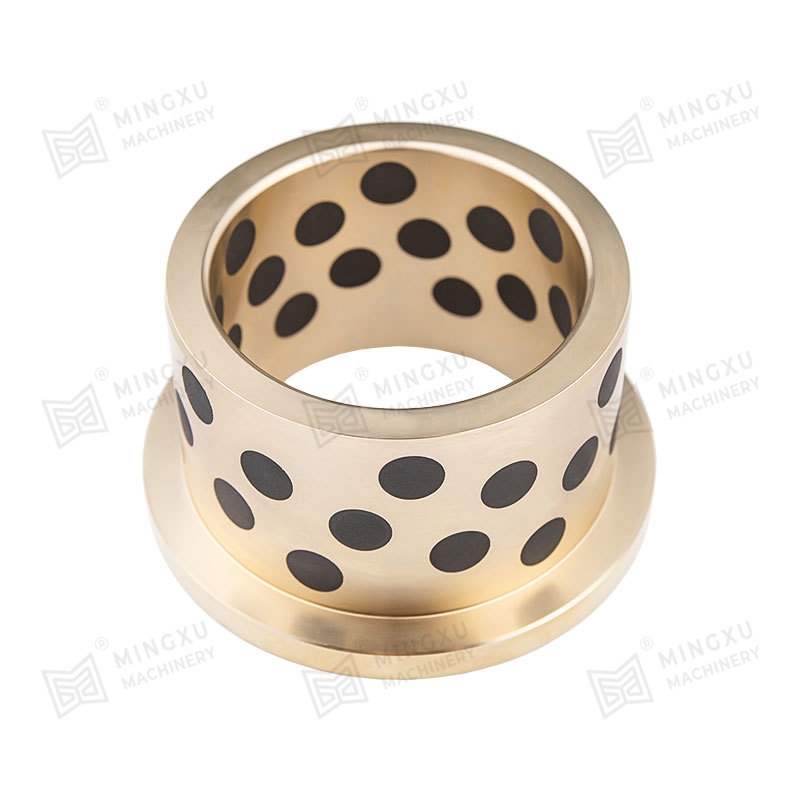
Coating or Surface Treatment:
Process: Coating involves applying a layer of material, such as a metal or polymer, to the surface of the graphite bushing.
Impact on Performance: Coatings can enhance the bushing’s resistance to friction, wear, and corrosion. They can also improve the bushing’s ability to operate in specific environments or with different types of mating surfaces.
Impact on Durability: Surface treatments or coatings can significantly extend the life of graphite bushings by protecting them from external damage and environmental factors.
Isostatic Pressing:
Process: This technique involves applying pressure to graphite in a fluid medium to produce uniform density and strength.
Impact on Performance: Isostatic pressing provides uniform properties throughout the bushing, resulting in consistent performance and high mechanical strength.
Impact on Durability: Bushings made with isostatic pressing have enhanced durability due to their uniform density and resistance to internal stresses and defects.
Hot Isostatic Pressing (HIP):
Process: HIP combines high temperature and pressure to improve the density and properties of graphite.
Impact on Performance: HIP-treated bushings exhibit superior mechanical properties, such as increased strength and wear resistance. This process also helps eliminate porosity and defects.
Impact on Durability: HIP-treated graphite bushings offer enhanced durability and reliability, with improved performance under extreme conditions.
Each manufacturing technique offers distinct advantages and potential drawbacks, and the choice of method depends on the specific application requirements, including performance, durability, and environmental factors.




 English
 Español






Contact Us